

By Hans Reinhart ‘the Elder’ (1500/10 – 1581)
For Maurice, Duke of Saxony (1521-1553)
________________________________________________________________________________
In 1544, Maurice, Duke of Saxony commissioned the renowned medallist, Hans Reinhart ‘the Elder’ from Leipzig, to create an exceptional medal, whose aim would be to prevent the splitting of the Christian faith, pleading for the unity of Christendom by reminding both parties – Catholics and Protestants – of their common believe.
________________________________________________________________________________
________________________________________________________________________________
In the early hours of a warm and sunny summer’s day, the loud and cheerful song of the birds could have been a sign that a peaceful and enchanting day was about to begin. But if you listened closely, you could hear a quiet, almost inaudible whisper in the midst of this cheerful song: «Father, into your hands I commit my spirit».
These few words were coming out through a small window, left open to the garden during the night in an innocent attempt to catch the little fresh air available at this time of the day. In the inside, a young man in his early 30th was lying in a bed placed in the darkest corner of the room, a preacher close to him. His reddish hair and beard where still flaming as ever, but the very pale colour of his skin and the pain in his voice were leaving no doubt. Today, on the 11th of July 1553, this young man will die. Two days earlier, he had been severely injured by a shot in his back as he was leading his troops during the Battle of Sievershausen near Hannover. His name was Maurice, Duke of Saxony.
Now that his life was coming to an end, a question that had been on his mind his entire life has become more challenging as ever: «will he die as a Protestant, as a Catholic or simply as a Christian?»
________________________________________________________________________________
Since Martin Luther had nailed its famous ninety-five theses on the doors of the All-Saints’ Church in the city of Wittenberg on the 31st of October 1517, this part of the Holy Roman Empire had been torn between the old Catholic and the new Protestant faiths. And Maurice was not spared by this religious dilemma. On a personal aspect, he had converted to the new faith along with his father, while having been raised as a Catholic. As the ruler of Saxony, he was torn between his will to remain loyal to Charles V, the Catholic Emperor of the Holy Roman Empire, and his support of the ‘Protestant cause’.
Ten years earlier, in 1544, Maurice, Duke of Saxony had commissioned the renowned medallist Hans Reinhart ‘the Elder’ from Leipzig, to create an exceptional medal whose aim would be to prevent the splitting of the Christian faith, pleading for the unity of Christendom by reminding both parties, Catholics and Protestants, of their common believe in the Trinity and the Athanasian Creed. There was born the so-called Trinity Medal, now considered without any contest the greatest masterpiece of German Renaissance medallic art.
________________________________________________________________________________
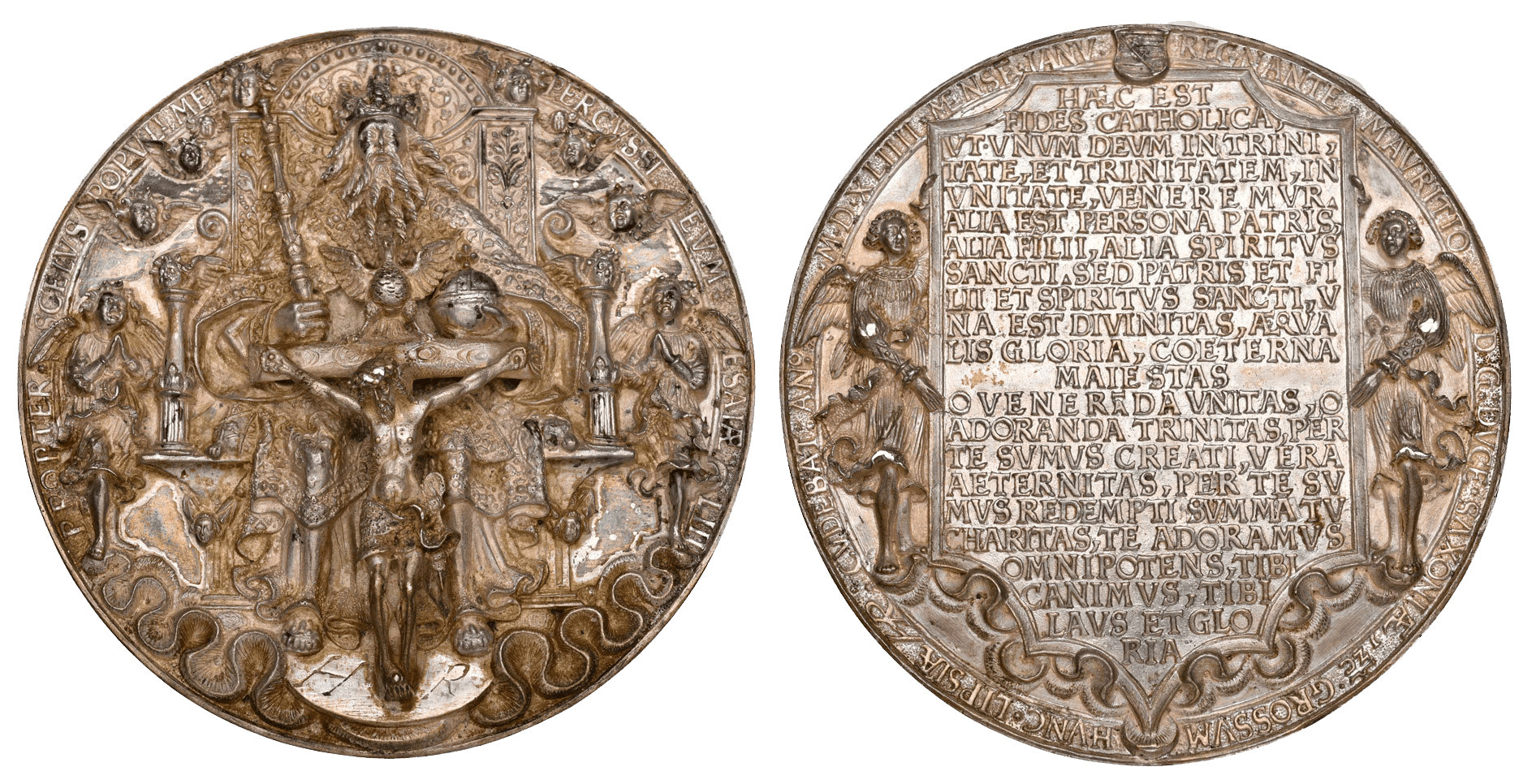
The Trinity medal by Hans Reinhart ‘the Elder’. Leipzig 1544. Silver 257 g.; 103 mm.
The obverse bears the representation of the Trinity, known in German as ‘the Gnadenstuhl’. God the Father is seated on a richly ornamented throne holding orb and sceptre. Before him, the crucifix surmounted by the dove of the Holy Spirit, Angels and cherubs are surrounding the throne. On the reverse, two standing angels hold a large tablet bearing the famous Athanasian Creed as a long inscription.
________________________________________________________________________________
This large Silver Medal cast in very high relief, is not only a real artistic tour de force, it can also be seen as a very high value diplomatic present used in a desperate attempt to safeguard peace and prevent one of the first religious wars between Protestants and Catholics in Central Europe.
Although this attempt had not worked out the way Maurice had hoped, and Europe would be almost destroyed by these religious wars for many following decades, this medal, one of only 15 estimated to exist (10 of which are in museums) is for us today an exceptional testimony of an attempt to use the power of beauty and art, in a desperate effort to safeguard peace.
________________________________________________________________________________
This rare, contemporary medal is part of an impressive collection of high-quality Renaissance medals that will be offered for sale in the upcoming Lugdunum Auction 24, taking place in Solothurn on Thursday, 12th of December 2024.