

Almost 600 years ago, in the dusty and dark workshop of a brilliant Italian painter, a work was created that would shape the history of art for centuries to come.
___________________________________________________________________________________
___________________________________________________________________________________
Antonio Pisano, called Pisanello (1380/1395 – 1450/1455)
John VIII Palaiologos, Byzantine emperor, attends the Union Council of the Roman Catholic Church in Ferrara/Florence, Italy, in 1438/1439
___________________________________________________________________________________
There, in the quiet and smoky atmosphere of a workshop, full of paintings and drafts, in the soft and dancing lights of some burning ashes, everyone was holding their breath as the master was leaning over what at first glance would have looked like a small block of sandstone. What was this object that looked like everything but a painting for which the painter was so famous?
Carefully brushing away the excess of warm sand, as an archaeologist would do to reveal the treasures from the past, a golden shine was starting to brighten the room and dazzle the artist. A large, round shaped lump of metal was appearing, and each delicate brush swipe was revealing more details of its surface and relief. First, appeared the contours of a beautiful portrait of a bearded man with curly hair. Then, the geometrical lines of what seems to be an unusual hat, that no one, besides the artist himself, might ever have seen before. Finally, on the outer line of the metal disc, as an almost perfect circle, large Greek letters forming an inscription, as those engraved on numerous recently discovered coins from ancient times. There was born, in the city of Ferrara, the first ever Renaissance medal, somewhere around 1438 and 1439, in the mind and through the skillful hands of a brilliant painter, Antonio di Puccio Pisano, best known as Pisanello (1380/1395 – 1450/1455). For the first times since Antiquity, has a realistic portrait appeared again on a medal.
___________________________________________________________________________________
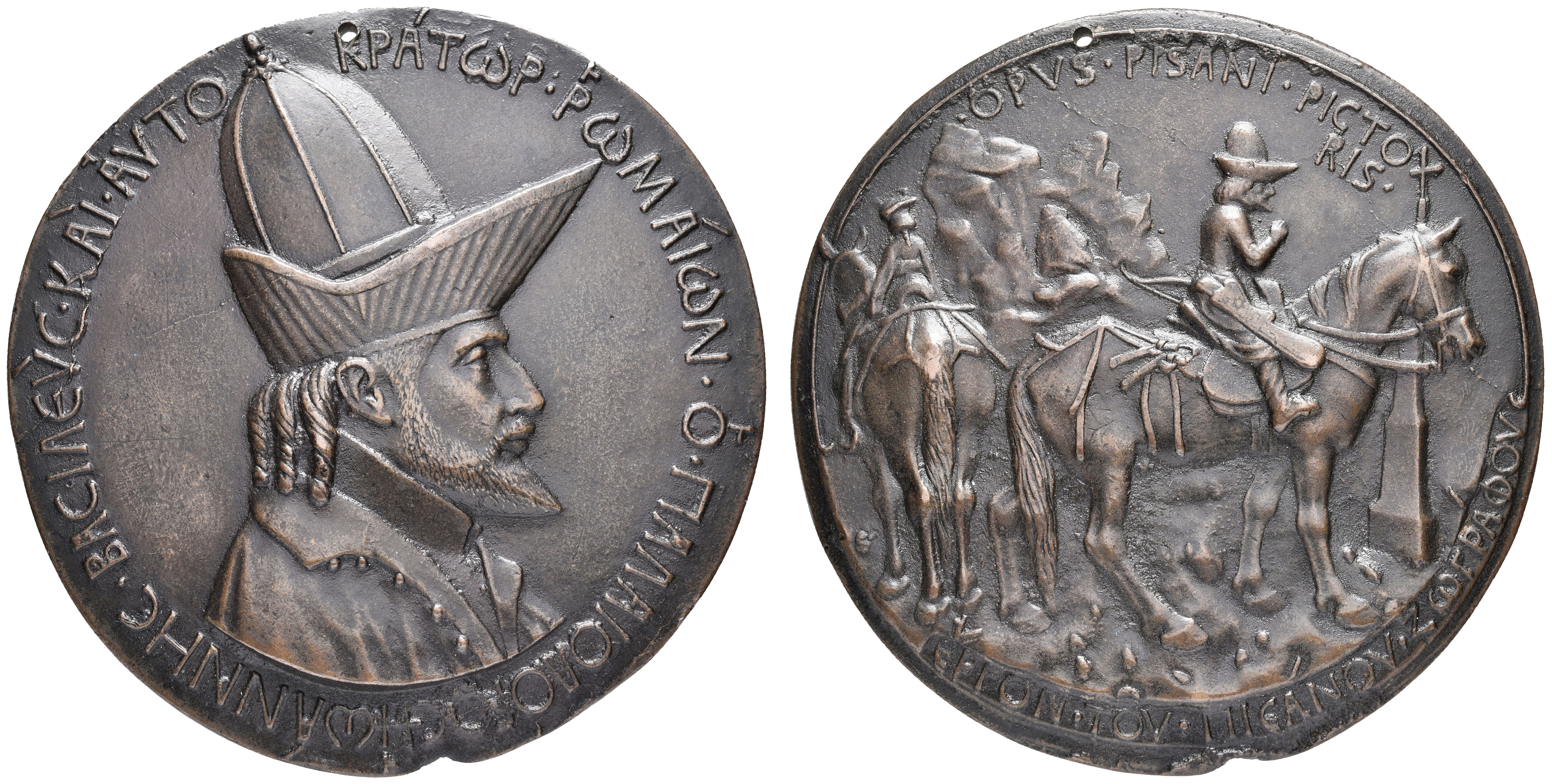
The obverse bears the portrait of the emperor to the right, with trim beard and moustache, curly hair, wearing a hat with a tall crown and a large, upturned brim, pointed in front, as well as a vest and cloak with a falling collar. The Greek legend presents him as the King and Emperor of the Romans. The reverse bears a charming scene where the emperor on horseback, accompanied by a monk, also on horseback, is engaged in a private prayer before a Latin cross set in a mountainous landscape. Wearing a bow and a quiver, the reverse also refers to the passion of the emperor for hunting.
___________________________________________________________________________________
With a diameter of 104 mm and a weight of 300 gr, it is an impressive medal, cast in bronze. Crafted to commemorate the visit of the Byzantine Emperor John VIII Palaiologos to Florence, Italy mid of the 15th century. As the Byzantine empire was on the verge of collapse, almost reduced to the sole imperial city of Constantinople, John VIII needed the assistance of the West in his fight against the Ottomans. For this purpose, he wanted to take part in person at the Council of Ferrara/Florence, whose aim was to negotiate a military support of the West, in return for the reunification of the Eastern Orthodox Church with the Catholics.
His visit was a success and lead to the issue by Pope Eugene IV, on 6 July 1439, of the Bulla Unionis Graecorum, temporary ending the East-West Schism and paving the way to a Western Crusade, by both land and see, against the Ottomans. Finally proclaimed on 1 January 1443, this western Crusade never took place, facilitating and allowing ten years later the conquest of Constantinople by Sultan Mehmed II on 29 May 1453 and the fall of the Byzantine empire.
___________________________________________________________________________________
In addition to the great artistic merit of this medal as well as its rarity, the political and religious contexts of its creation make it even more interesting, as it marks both the begin of the rich production of Renaissance medals that will revolutionize European medallic art, but also in some way the End of the over 1’000 years old Byzantine Empire.
___________________________________________________________________________________
This rare, contemporary medal is part of an impressive collection of high-quality Renaissance medals that will be offered for sale in the upcoming Lugdunum Auction 24, taking place in Solothurn on Thursday, 12th of December 2024.