

Crafted in Florence around 1485, this medal commemorates one of the most important humanists of the Renaissance: Giovanni Pico della Mirandola. It is of the greatest rarity, as it is the only original contemporary specimen known to have survived the passing of time.
__________________________________________________________________________________
Medal by Niccolò Fiorentino (di Forzore Spinelli) (1430-1514)
For Giovanni Pico della Mirandola (1463-1494), scholar, philosopher & humanist
__________________________________________________________________________________
On a cold and windy winter day, the city of Florence, usually calm and quiet at this time of the year, was woken up by a swarm of young people strolling in the streets. Like tireless ants, they followed each other by the tail, holding in their hands all kinds of objects.
For the last couple of days, these young people have been knocking at the doors of each house of the city, asking the inhabitants to gather all their books, cosmetics and objects of art as ordered by the new ruler of the city, the infamous Dominican friar and preacher Girolamo Savonarola. Now was the time to hand them over.
On that very day, Shrove Tuesday, 7th of February 1497, all those objects, now considered as occasion of sins, have been destroyed and burned down in an immense fire in the middle of the public square Piazza della Signoria in Florence. A tragic event that history has recalled as the ‘Bonfire of the Vanities’.
__________________________________________________________________________________
Among the objects of art that should have been destroyed on that day would have been a medal, representing everything Savonarola hated: an exceptional individual with an insatiable thirst for knowledge and a profound reappropriation of ancient wisdom.
This medal, with a diameter of 85.6 mm and a weight of 338 gr., is attributed to the Florentine medallist Niccolò Fiorentino, and was crafted in Florence around 1485. It commemorates one of the most important humanists of the Renaissance: Giovanni Pico della Mirandola (1463-1494). It is of the greatest rarity, as it is the only original contemporary specimen known to have survived the passing of time.
__________________________________________________________________________________
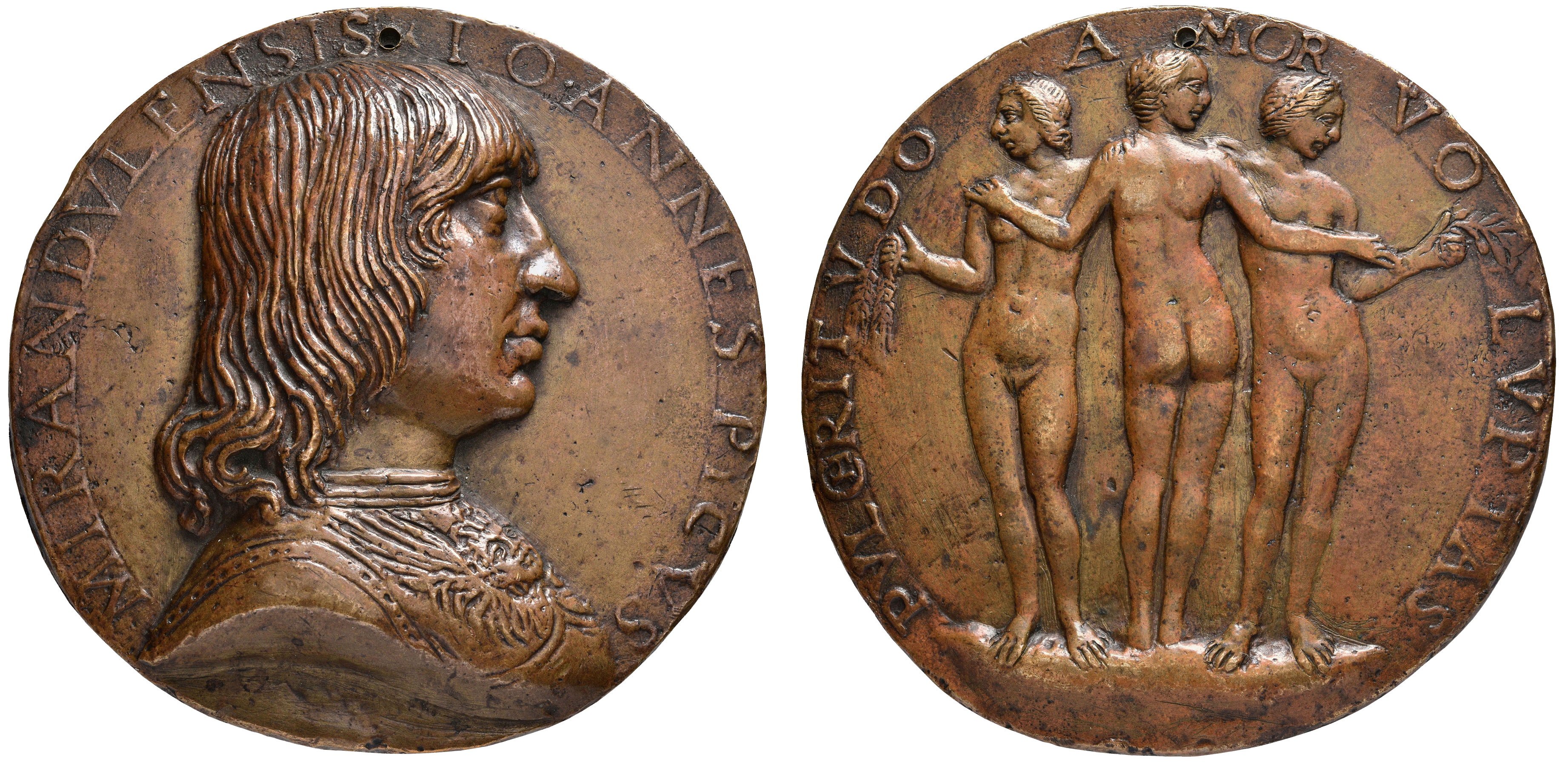
Medal by Niccolò Fiorentino (di Forzore Spinelli). Bronze 85,6 mm; 338 g.
The obverse depicts the bust of Pico, looking to the right with long hair and decorated armour. The reverse, three standing naked women, also known as the three Graces from Greek mythology Euphrosyne, Thalia und Aglaia.
__________________________________________________________________________________
Born in 1463 in Mirandola, north of Florence, Pico was regarded as the most knowledgeable man on earth by its contemporaries. At the time of the production of this medal, he had started the redaction of his 900 Theses, compiling his views on all known doctrines and philosophical knowledge from both Western and Eastern cultures. Its aim was to form the basis for a large congress of Scholars against which Pico would defend each of his 900 theses. Sadly, this congress was halted by Pope Innocent VIII who eventually condemned all Pico’s theses, leading to his excommunication, the destruction of all copies of his book and the settling of Pico della Mirandola in Florence under the protection of the Medici Family. His premature death at the young age of 31, on the 17th of November 1494, contributed to make Pico della Mirandola an even more fascinating figure, as have also recent forensic analysis, made on his exhumed body, by revealing that Pico had been assassinated by arsenic poisoning.
The reverse iconography depicting the three Graces from the Greek mythology in whom beauty was deified, appears here for the first time since antiquity on a medal and will have a large success for the following centuries. The representation was inspired by an antique statuary group found in Rome toward the middle of XVth Century. It can still be admired today in the Piccolomini Library in the Duomo of Siena, where the Three Nude Graces stand as a symbol of the recovered beauty of Antiquity placed into the heart of Christianity.
Although inspired by antiquity, the legend AMOR VOLUPTAS PULCHRITUDO, is a reference to the philosophical works of another important humanist of the time: Marsilio Ficino (1433-1499), a priest and teacher of Pico della Mirandola, active in Florence, where he founded his Florentine Academy, as an attempt to revive Plato’s Academy.
This exceptional medal can be seen, as an intemporal echo from the Renaissance, bringing to our modern eyes, cast in bronze, the main values humanism stands for: beauty and wisdom.
__________________________________________________________________________________
This rare, contemporary medal is part of an impressive collection of high-quality Renaissance medals that will be offered for sale in the upcoming Lugdunum Auction 24, taking place in Solothurn on Thursday, 12th of December 2024.